

rewrite this content and keep HTML tags
In this week’s news round-up, we’re celebrating the old with something new… and in several cases, the new is still poised to be revealed to the masses.
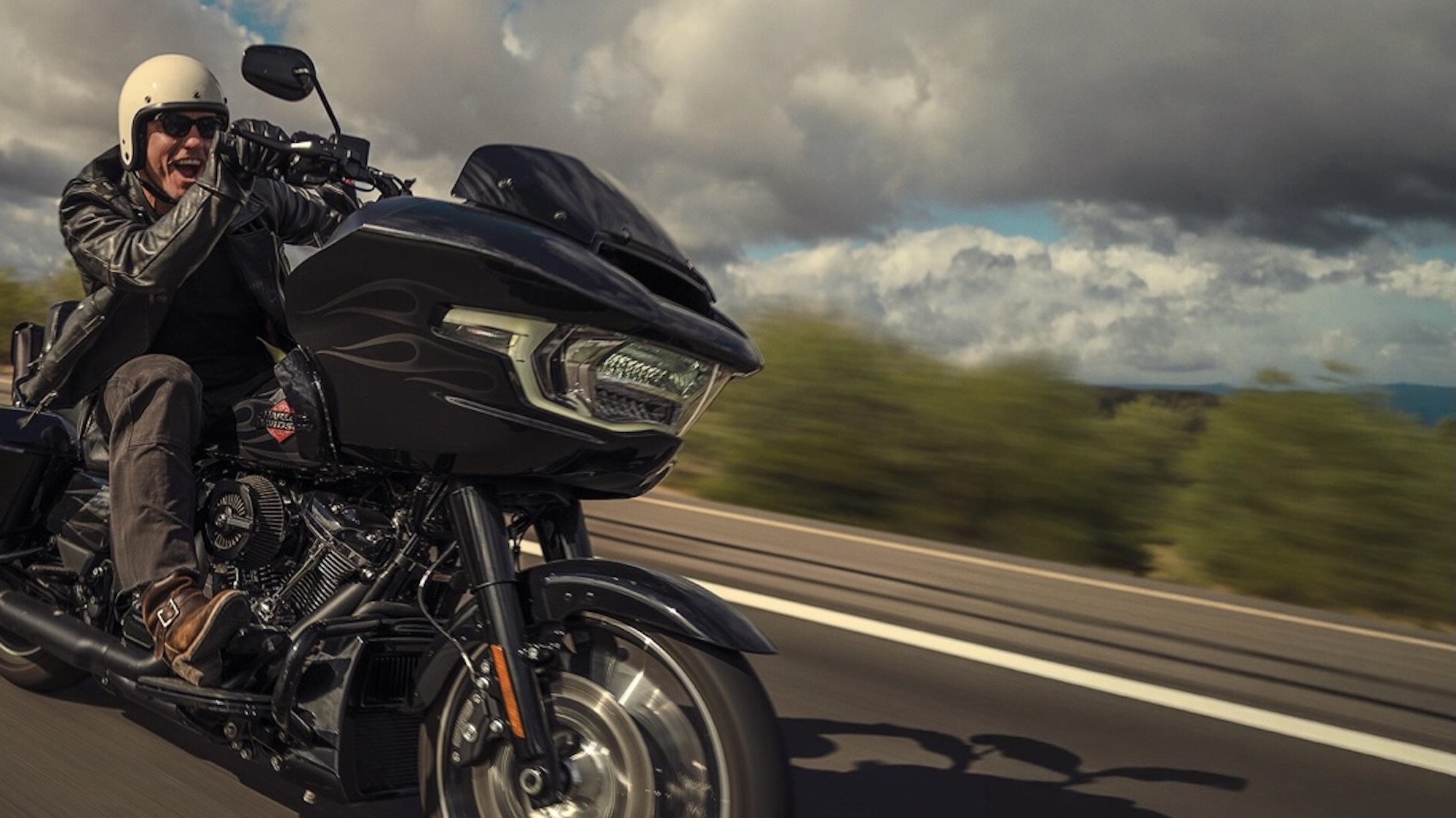
Harley-Davidson files papers for a “Low Bob” and a model they’re calling “Deadwood.”
CEO Artie Starrs’ new “Back to the Bricks” Strategy comes with a massive set of caveats under the proverbial hood; we dissect the factory’s post-release Cautionary Note to outline the best-case and worst-case long-term scenarios.
To kick off its 100-year centenary celebrations, Ducati has unveiled the rather ostentatious “Collezione 100” for their most hardcore Ducatisti.
Yamaha is poised to give the entry-level commuter market a new contender: The R2.
Let’s begin with Harley-Davidson’s new bike filings (and anticipations for the future), shall we?
New Bikes Ahoy: Harley-Davidson Files Trademark for “Deadwood”
New Model Name Surfaces Suggesting Sturgis Support
A view of a custom Softail Street Bob connected to Thunderbike Harley-Davidson. Media sourced from Thunderbike.
Our good industry’s filing logs are providing a good glimpse into a long-term portfolio unfolding out of Milwaukee proper. According to Motorcycle.com, Harley-Davidson has filed for the name “Deadwood” alongside a secondary request for the name ‘Low Bob.’ The papers include rather strict regulation protections, suggesting that Harley’s actively positioning both titles for future model production (instead of lifestyle merchandise, apparel, or casual accessories).
As for why Harley went for the name “Deadwood,” we have a few guesses, though not many. The name Deadwood has never been in the company’s previous lineups, though Motorcycle.com’s Dennis Chung reminds us that “Deadwood Green” was once carried forward in 2021 as a paint tone. The name Deadwood also carries an undeniable history for Harley as a connection to Sturgis – which, by the way, was where Harley-Davidson celebrated their new dealership’s first-ever sales last year, proving that – no matter what the times bring – the Company considers their Sturgis footprint a worthy investment.
While the “Low Bob” name suggests a highly predictable crossover pairing (bobber-esque Softail Milwaukee-Eight, anyone?), the bike’s personality remains in the dark. Industry analysts indicate it could be a new, nostalgia-heavy heritage cruiser equipped with retro-spec leather luggage; on the other side of the equation, there is potential for Harley-Davidson to be using the name “Low Bob” to help rebrand their liquid-cooled Revolution Max segment.
Bottom line, Harley-Davidson is obviously filling out their lineup with model examples that will point back to the mecca of V-twin aftermarket culture, and we can’t wait to see what’s in store as the riding season progresses.
Industry Insider: Harley-Davidson PR Cautionary Note Tells Riders What’s Coming Down the Pipeline
The Risks and Rewards of Harley’s “Back to the Bricks” Shift
A view of Artie Starrs visiting the Thunderbike crew. Media sourced from Thunderbike.
The timing of the Deadwood and Low Bob filings, by the way, runs alongside CEO Artie Starr’s multi-year “Back to the Bricks” strategy, a turnaround plan designed for stabilizing Harley-Davidson following the Company’s recent mixed financial results and inventory pressure. Focus in this new strategy lies famously on upping dealer profit, the lifecycle of HD parts and accessories, and bringing in entry-level models.
Perhaps even more interesting is the plethora of news hidden in a cautionary note bookending one of Harley’s more recent news releases. In this note is a list of every single thing that Harley believes could realistically derail their strategy’s promises to their investors (investors can’t sue if things go sideways, provided they are warned first).
We decided to take a look at the cautionary note and summarize our findings below (I wasn’t about to introduce a 1700-word nosebleeder here, so you can find the original post-release cautionary note on Harley-Davidson’s investor website).
Here’s what we found so far:
Harley is shifting away from the ultra-premium, heavy-touring focus of the previous era and toward accessibility and customization.
If Harley-Davidson successfully navigates the risks outlined in their releases, the average rider stands to inherit a VERY accessible and community-focused brand.
Harley wants to re-introduce the Sportster family.
Should this be successful, riders will be further pushed towards a more affordable and traditional air-cooled cruiser platform… and a very nice blank canvas for garage tinkerers.
Harley’s focus also includes the launch of the lightweight “Sprint” platform.
To Starr, Sprint riders will have a genuine pathway to the brand without taking on substantial debt.
Plans are now in place to reinstate up to 30% of previously discontinued Parts & Accessories catalog items.
For the HOG enthusiast, this means maintaining or customizing older machines will be that much easier.
Harley slashed floor plan inventory by 24%.
dealership networks will hopefully balance out, providing competitive retail financing rates through HDFS with fewer dealer markup fees on hot models.
Of course, not everything is sunshine and daisies, and the above would only be possible if everything worked out for Harley-Davidson. In balancing the tightrope act of the company’s “Back to the Bricks” Strategy, there are still a few unfortunate things to keep an eye on:
Harley’s Cautionary Note details a known quality and regulatory issue that’s affecting brake hose assemblies sourced from Proterial Cable America.
If this blows out into a full safety recall campaign, riders might have to wait until replacement components can be validated, manufactured, and distributed before getting back in the saddle.
Watch for international trade routes affecting raw material costs for metals and electronics.
Worst case, there is a large chance that Harley will have to pass these operational expenses directly to the buyer, and backorders will also mean a longer wait time for a routine warranty fix or minor collision repair.
If the electric powersports market remains frozen and LiveWire continues to drain Harley’s primary cash reserves, the main brand will be forced to tighten the proverbial belt and pull funding out of Harley’s ICE R&D to prop up the deficit.NOTE: (see “…optimize capital allocation in light of the Company’s capital allocation priorities,” (a) and (ii), etc.)
If LiveWire is not successful, then Harley-Davidson’s “full enterprise economic model” (a) is compromised, forcing leadership to “optimize capital allocation” (ii), or pull cash from Harley’s R&D to stay afloat.Four years ago, the industry was caught up in LiveWire going public and celebrating LiveWire’s success; a short two years later, and LiveWire kept appearing in HD financial statements with minimal sales, changing public opinion of LiveWire’s independence. Now, LiveWire’s survival hinges on their riders’ willingness to adopt electric platforms as well as LiveWire’s own ability to secure outside funding.
In the event that dealer networks struggle to secure independent capital or properly manage the supply and pricing of used motorcycles, Harley bike trade-in values could drop.
Watch for the potential of dealers increasing labor rates on service to survive those low times.
Ultimately, Harley-Davidson is walking an economic tightrope to stay true to their heritage history while winning a wider diversity of demographics – all while external trade and quality factors remain more or less on the line.
Who needs a lemonade?
Centenary Masterpieces: Ducati Unveils Ultra-Limited “Collezione 100” at Mugello
Ten Iconic Models Capped at Just 100 Units Worldwide
A view of Ducati’s new Collezione 100 – a collection of motorcycles inspired by the Mugello circuit and many memorable heritage Ducati machines. Media sourced from Ducati.
No one does “exclusive” quite like Ducati, and their 100th birthday is the perfect chance to drop an insane collection of specially-designed luxury machines for Ducatisti worldwide.
This year’s dramatic, art-driven rollout is inspired by the pit lane of the Mugello circuit. Dubbed the Collezione 100, Ducati’s recent press release tells us that riders will have access to a highly exclusive run of ten distinct models, each lifted from a segment of the brand’s model lineups. Every single variation within this swanky centenary collection is strictly limited to 100 numbered examples globally, and here are the names of each model (as well as the beauty after which they’ve each been styled):
Panigale V4 S – 1972 Imola Desmo
Panigale V2 S – 1975 Super Sport Desmo
Streetfighter V4 S – 1979 900 Sport Desmo Darmah
Monster – 2008 Monster S4Rs Tricolore
XDiavel V4 – (Cook Neilson’s) 1977 750 Super Sport “California Hot Rod”
Diavel V4 RS – 1979 900 Replica
Multistrada V4 RS – 1979 SL Pantah
Scrambler – 1962 250 Scrambler
Hypermotard V2 SP – 1975 860 “24 Horas de Montjuïc”
DesertX – 1981 Pantah “Ice”
Mechanically, the bikes are outfitted with high-end, model-specific components. While the relevant sport and naked models receive mechanical dry clutches and lightweight racing exhaust systems as standard equipment, Centenario Bronze finishes are given to the brake calipers and fuel tank cap rings of all members of the collection. Each bike also comes with a serialized plaque riveted directly to the machine’s billet-machined triple clamps, a formalized certificate of authenticity, and color-matched rear paddock stands, all of which is complemented by premium seats embroidered with specialized logos. Oh, and to make starting the bike a whole new experience, Ducati has also included a special “ignition ceremony.”
As if all that weren’t enough, North American buyers will have the additional perk of getting a limited-edition heritage helmet and leather jacket cut to match their specific machine’s livery. Delivery of each model will also come alongside a pair of numbered fine-art prints bearing the exact serial number of the bike, hand-signed by renowned Italian artist Ugo Nespolo.
Following their trackside debut alongside the works team Desmosedici GP bikes, we’re told that the collection will be displayed at World Ducati Week (July 3, 4 and 5) before hitting up the Goodwood Festival of Speed and then finding a permanent home in museums throughout the region.
Fast Filings: Yamaha Targets Entry Segment with “YZF-R2” Trademark
A New Affordable, Single-Cylinder Sportbike is Readying for Western Markets
Yamaha appears to be finalizing the development of an all-new displacement class for its beloved R-family.
According to findings from the incomparable Ben Purvis at CycleWorld, filings connected to a “YZF-R2” had been revealed as far as five years ago alongside the appearance of the name “YZF-R9.” With the R9 now a reality in our markets, a heavy wave of registration movement is continuing to be tracked surrounding the R9’s younger sibling. Official registration acceptances have been confirmed for United States, as well as Canada, Europe, Brazil, and India, following a nearly identical path to the registration and launch pattern of the YZF-R9.
Additional proof of the R2’s debut stems from Yamaha’s decision to lock down the model’s nameplate for the United States – a country that has federal trademark rules put in place specifically to discourage “zombie” trademarks, or filings that are registered and then stagnate.
For those of you wondering: When an OEM like Yamaha files a trademark for a name like “YZF-R2” before the bike is built, they file for the U.S. markets under Section 1(b): Intent-to-Use (ITU). Once the United States Patent and Trademark Office (USPTO) reviews and clears the name of any conflicts, they issue an official Notice of Allowance (NOA). From there, the company has six months to either file a Statement of Use (SOU) proving the bike is actively being commercialized in the US market, OR file a formal extension request.
OEMs can’t get their product into the U.S. unless they can show that they intend to release the product to markets within a set amount of time – and even if they apply for an extension, those same OEMs have no more than 36 months (3 years) from the Notice of Allowance date to actually debut the machine and submit commercial proof (like dealership invoices, shipping manifests, or official public marketing layouts).
Anyways.
Now that we know this, we also know that Yamaha is running out of time to release their R2, which was filed in the United States, thereby proving the clock is ticking on the R2’s debut to America.
We also know by now that the YZF-R2 will bridge the massive performance and financial chasm currently separating the entry-level R15 single and the twin-cylinder R3. Because of the machine’s placement in Yamaha’s R-type lineup, the R2 will likely have something along the lines of a scaled-up, bored-out version of the R15’s platform, boasting around 200cc (or around 24 horsepower) to complement a rigidity-optimized Deltabox chassis, a Switchable Traction Control and Quickshifter combo.
Summary: Yamaha’s giving us a fuel-efficient R-type sportbike with nimble handling dynamics without adding the manufacturing costs or unsprung weight associated with a parallel-twin setup. And it’ll be here soon.
Mazel.
*Media sourced from Yamaha, Ducati and Harley-Davidson*