

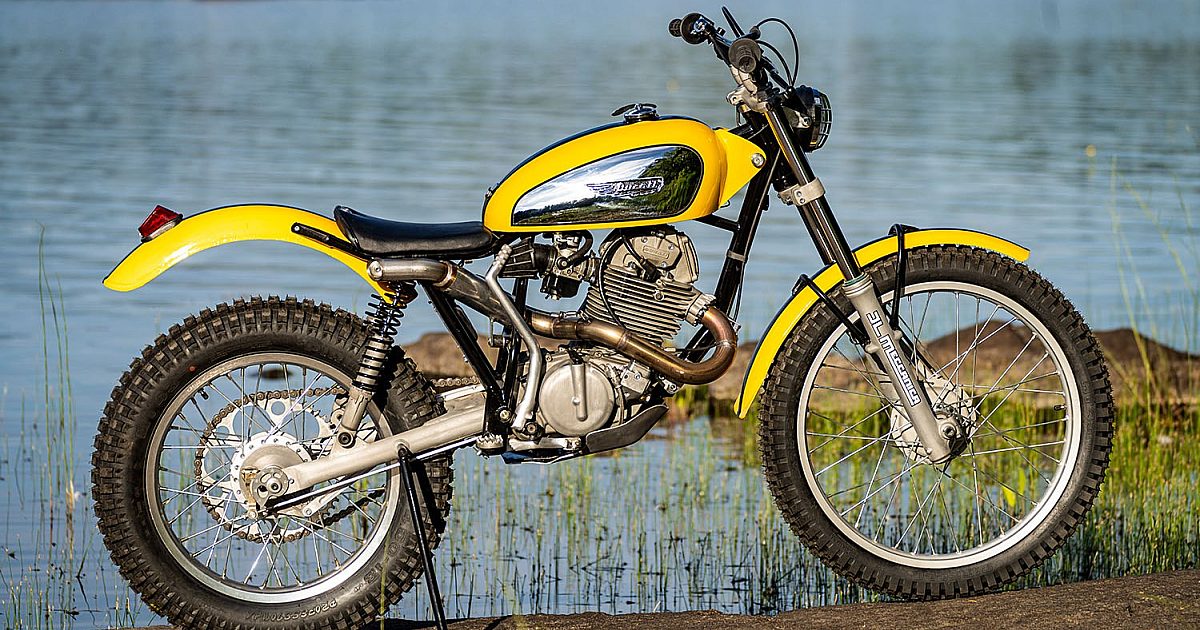
The most common path in the motorcycle world starts with a dealership and a big check. If you’re reading these pages, then you likely fancy a bit of customization, but the rabbit hole goes deeper. For some, it’s not enough to base their project on something that already exists; only a chassis of their own design will do. Janne Leiman is one of those people, but even more impressive is the fact that Janne also built his engine from various bits of scrap, including Cagiva bottom-end bits, a Ducati Monster cylinder and a Lynx snowmobile connecting rod.

Janne hails from Mänttä, Finland, where he operates a one-man frame-building operation called JL Mekaniikka. He’s been building frames for 30 years and has made it his livelihood for the last 20. Frames, swingarms and suspensions for vintage and classic racing bikes are his usual fare, but he works with the occasional street bike as well. Engine building is usually relegated to a hobby because it eats the clock, but Janne felt the need to do something special to celebrate Ducati’s Centenary.
While Janne knew he’d never field one in competition, his interest in vintage trials bikes grew with every one that went through his shop. Early twin-shockers that compete in the Pre-85 class, specifically, and it would be entirely hand-built. If that weren’t enough, Janne also had a desire to construct a four-stroke engine based on a two-stroke bottom end. Why not do both at once?

The foundation of the build is a salvaged Cagiva Mito 125 bottom end. The donor motor had a grenaded connecting rod bearing, which hardly mattered since the crank was slated for heavy surgery. The crankshaft was torn down, rebalanced and drilled for custom oil channels. It was then pressed back together with a heavy-duty Rotax 550 connecting rod pilfered from a Lynx snowmobile. To secure the wide-ratio gearing and kickstarter mechanism required for low-speed, high-torque trials sections, internals were harvested from a Cagiva Elefant 125 and shoehorned into the Mito cases.
The top end delivers the required Ducati tribute. A Monster 695 cylinder and piston meet a 750 Supersport cylinder head. Merging these large-displacement four-stroke components with a 125 cc two-stroke case demanded heavy machining. The crankcase mouth was bored out significantly to accept the larger cylinder skirt. Cylinder studs were relocated, and a bespoke adapter plate was machined in-house to bolt the two disparate halves together securely.

Driving overhead valves from a two-stroke crank required an entirely custom timing setup. A new flywheel and a toothed belt pulley were machined specifically for the left side of the crankshaft. Up top, another custom pulley drives the camshaft. The timing belt is routed via a series of fabricated idler wheels and tensioned by a stock Ducati unit.
Lubrication is fed by a Jawa DT500 speedway oil pump driven off the right side of the crank. Janne took the extra step to sand-cast his own left-side engine cover, belt covers and oil pump mounts. He also machined the oil pump shaft and routed custom hard lines, a filter screen and breather components from scratch. Fuel dumps through a DellOrto PHBH 28 carburetor capped with a Malossi filter originally meant for a Ducati F1. Spark comes from an Ignitech CDI generously supplied by sponsor Juha Tanila. Exhaust gases route through a handmade pipe and silencer, tucked against the chassis with OE precision. The final bore and stroke sit at 88 mm by 50.6 mm, resulting in the wildest 308 cc mill we’ve ever seen.

With the engine sealed, it went straight into the chassis jig and Janne started bending 25CD4 chromoly steel tubing (25CrMo4 in Europe and 4130 in the States). The purpose-built frame has loads of ground clearance, and a low seat height and short wheelbase for maneuverability. Finish-welded, the frame weighs less than 4.5 kg [10.14 lbs]. The custom swingarm is fabricated from oval 6082 aluminum tubing braced with sheet metal gussets to handle off-camber drops.
Suspension required a blend of old aesthetics and new technology. The rear shocks are a set of vintage aluminum Marzocchis that Janne scored from a local bike breaker. In need of a total restoration, Janne sent them off to the specialty shop Hakala Service, where the period-correct bodies were machined to accept 10 mm shafts and stuffed with modern YSS damping internals. Up front, a Yamaha XV750 fork was completely gutted. Only the heavily modified lower legs remain from the Japanese cruiser, now holding lighter tubes and updated valving tuned specifically for trials riding.

Rolling stock meets Pre-85 trials regulations with drum brakes front and rear. The front wheel features a Suzuki PE175 hub while Janne believes the rear is of Honda origin. Both hubs are laced to a 21-inch front and 18-inch rear rim wearing sticky Pirelli Trials rubber.
Trials bodywork is built to take a beating, making paint a liability. Classic Goneli plastic mudguards are wrapped in yellow vinyl because painting flexible plastic is a straight route to flaking and failure. The steel fuel tank is a genuine Ducati 350 Scrambler unit. “It’s all too heavy,” Janne responds about the tank, “but I find it so beautiful that I can not resist it.” A minimalist fiberglass seat pan with basic padding and black vinyl caps off the bodywork.

Lighting is provided by Bosatta, switchgear is CEV and the controls are universal trials fare. The custom bash plate and rear brake pedal are one-off fabricated pieces designed to take rock strikes. Fully fueled and oiled, the Janne’s bike weighs just 87 kg [192 lbs], a figure that holds its own among its contemporaries.
All said and done, Janne’s build is an engineering and machining marvel, with the perfect period-correct look, but how does a scratch-built trials bike honor Ducati’s history — a firm that never built a trials bike of its own? There is historical precedent here, as famed British trials rider Peter Gaunt built multiple Ducati-based bikes in the 1960s, combining a 160 Monza Junior frame and a 350 cc desmodromic race engine. That’s reason enough in our minds, but when a build incorporates this high level of thought, skill and execution, there’s simply no need to ask why.