


Children are impressionable, particularly when bikes are concerned. That magical mixture of sound, scent and hazard has a approach of imprinting itself on younger minds. However Kyle Harvey didn’t simply dream of bikes as a toddler—he virtually grew up with them.
Kyle’s commerce is software and die making, however his ardour is constructing bikes. His father, Garth Harvey, acquired Kyle and his brother into bikes at a younger age; as quickly as they might begin their previous man’s classic bikes, they had been driving them. Residing in Edenvale in South Africa’s Gauteng province, the boys additionally had direct entry to the native Traditional Motorbike Membership.
The oldsters on the CMC made fairly an impression on younger Kyle—and taught him every little thing he is aware of about classic bikes. After serving to quite a few associates work on their bikes, he went on to open his personal store, named merely ‘The Workshop.’ Kyle has been constructing and restoring basic bikes for over a decade now.
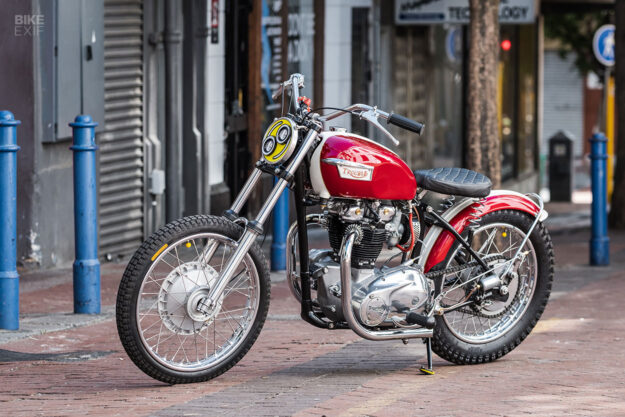
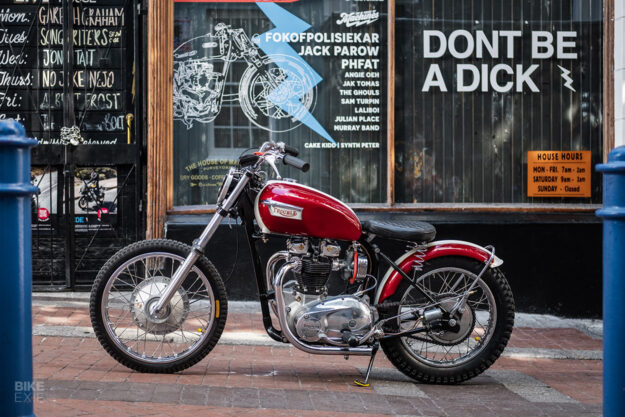
This cheeky bobber is his newest construct, and it’s immensely fascinating. The engine’s from a Triumph TR6 Trophy, the body is from a Matchless, and the quirky handmade particulars on it are infinite.
Kyle’s creativeness was sparked when he stumbled throughout a 1946 Matchless G80 body round 5 years in the past. He wished to construct a bobber that shied away from the stretched-out hardtail look, and the brief Matchless body was precisely what he wanted.
To prep the body for the 1971 Triumph TR6 Trophy engine chosen for the construct, the spine was lower out and changed with an oil-bearing one. After that, the engine went in easily, with the underside a part of the body matching up completely.
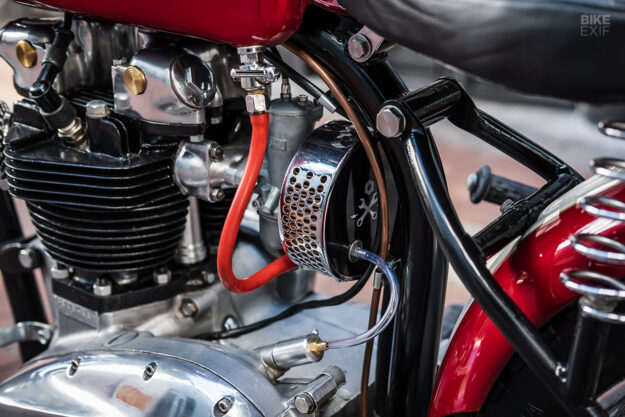
The motor itself wanted a full rebuild. Earlier mannequin rocker covers had been modified to suit it, then polished, whereas the top and barrel had been painted black as a nod to older Triumphs. The ignition was changed with a self-generating unit, fitted the place the alternator was once.
The engine sucks gasoline and air by way of a brand new 32 mm Amal carb with a pancake filter, and makes noise by way of a pair of slash-cut pipes. For an ultra-clean look, it runs and not using a battery.
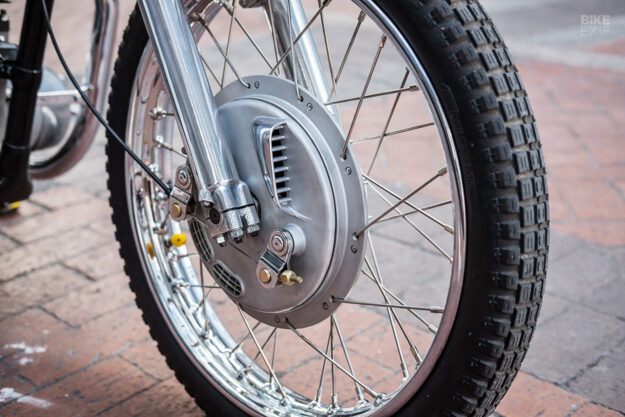
The wheels characteristic Triumph and BSA conical hubs, which had been blasted to get one other 50 years of use out of them. Kyle lower down the inside track on the entrance drum and polished what was left. The brass particulars are a very good contact—as are the smiley face valve caps.
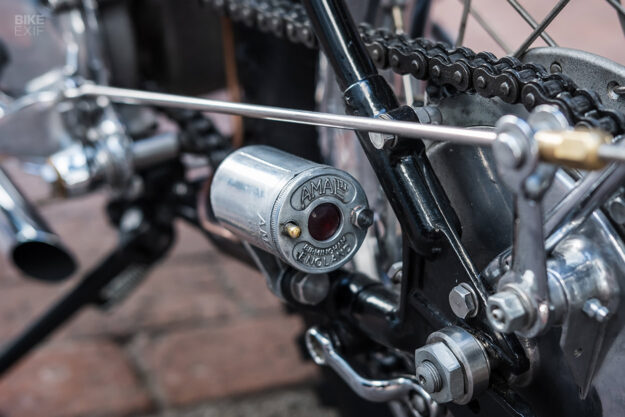
“I attempted to make use of as a lot as I may from my shed stuffed with spares and previous scrap,” says Kyle. “The pinnacle regular and brake keep are comprised of previous spanners. The brake rod I comprised of stainless-steel rod, after which welded a shackle from my crusing toolbox on the opposite finish.”
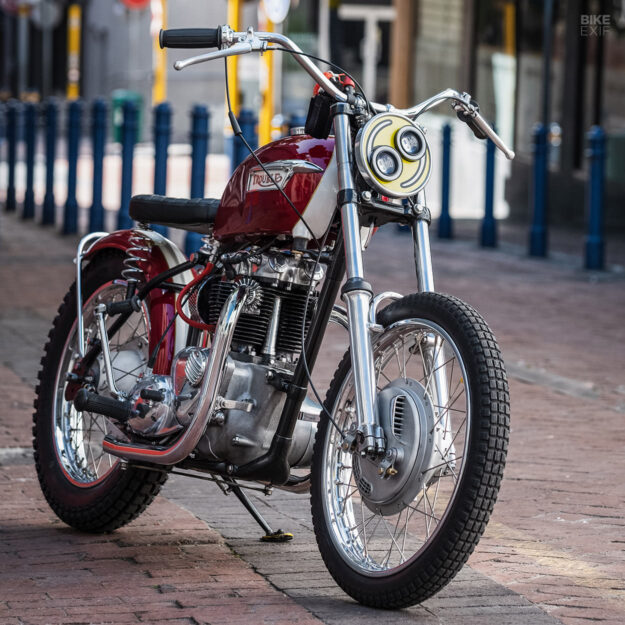
Protecting the body’s spine is an American-spec 1969 Triumph Bonneville tank. The American Bonnie had a skinnier tank than its British counterparts, and it seems to be excellent on the stripped-back bobber.
To melt the journey out the again, Kyle made a saddle that pivots on the entrance and is sprung on the again. Expertly diamond-stitched in leather-based by Wynberg Auto Trimmers, it seems to be like a pleasant sufficient place to take a seat—particularly behind these extensive, relaxed bars.
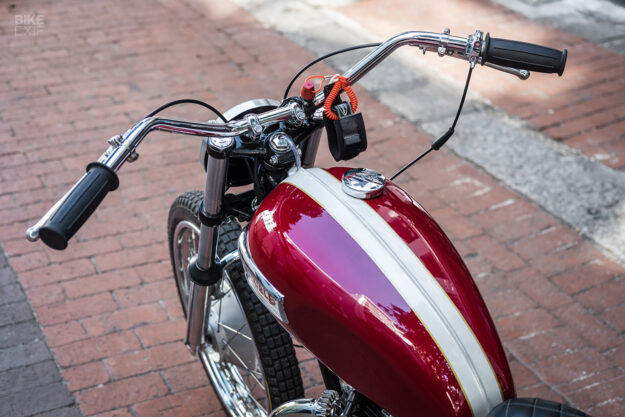
The dashboard is painfully easy; there’s barely something there. The bars put on Lowbrow Customs grips, duplicate Amal levers and little else, save for a primary kill swap.
“The kill swap is fitted with a surf leash,” Kyle factors out. “This manner, I can take the bike all the way down to the seaside, go for a swim and never lose the important thing! It additionally jogs my memory of a speedway bike my brother as soon as owned.”
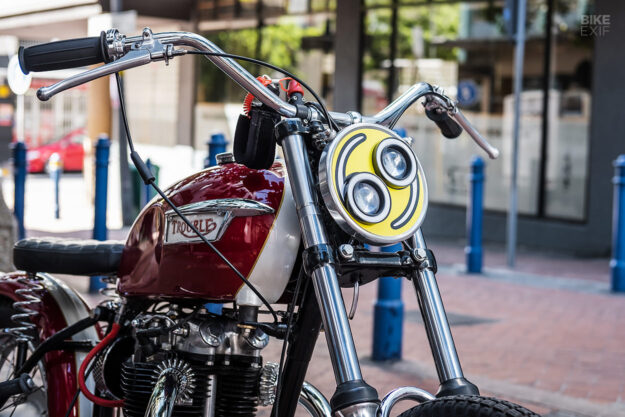
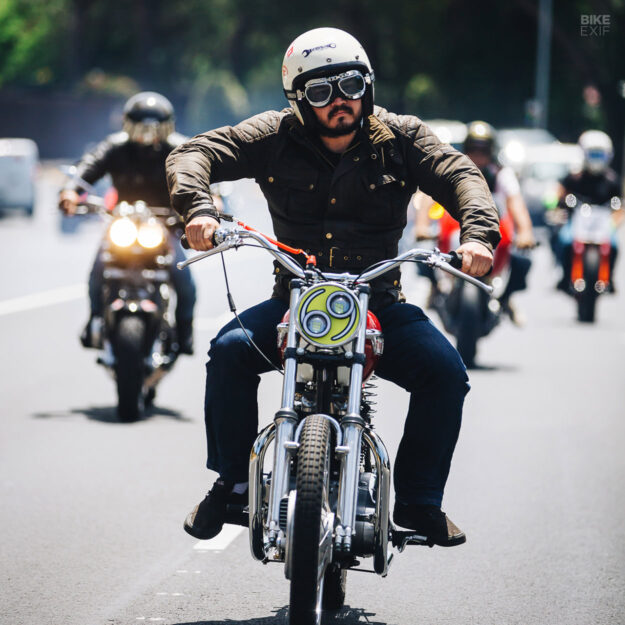
Mounted to a set of Triumph forks is a novel headlight nacelle, fabricated by Kyle. The lights are LEDs, and the ’69’ decal was made by a neighborhood store, Print Design Studio. There aren’t any flip indicators, however there’s a taillight—it was comprised of an previous Amal carb housing, and bolted to the rear foot peg mount.
The bike was an all-hands-on-deck sort of construct. All of the mudguard stays and brackets had been made in-house, and Kyle’s dad laid down the pearl white and sweet purple paint himself. The rear mudguard was lifted from a BSA and painted to match, giving the bike an old-school sizzling rod vibe.
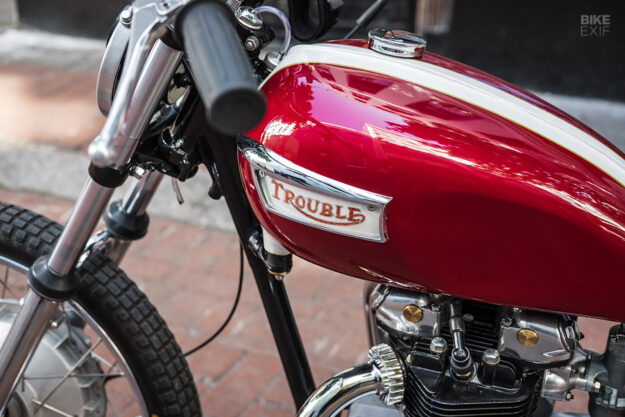
Lastly, Kyle’s sister-in-law drew the “Bother” logos on the gasoline tank, by hand.
“The identify comes from serving to my brother construct his first bike—a 1962 Triumph Tiger 110,” explains Kyle. “It was constructed from scratch and we actually battled with it. Happily, my dad taught us to by no means surrender, and we lastly acquired it proper. Since then, all Triumphs are thought of hassle.”
Extremely, although Kyle had been accumulating elements for years, this bike was inbuilt solely 4 months. If having a toddler and transferring home weren’t sufficient strain, Kyle learnt that Africa’s premier customized bike present, The Lightning Bolt, was returning to Cape City. So he pushed on and debuted the bike on the present.
“I want to thank everybody who helped me with the bike,” he provides. “Particular because of my buddy Tristan for all the assistance with little bits within the workshop, and Greg and Jimmy from the Edenvale Traditional Motorbike Membership for the chroming.”
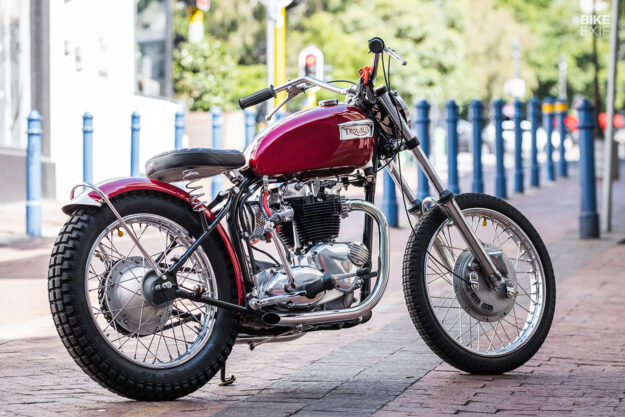
If Kyle’s Triumph and Matchless hybrid proves one factor, it’s that the subsequent technology of motorbike builders is in good palms.
The Workshop Instagram | Photos by Wes Reyneke [above] and Andy Lund [below]