

by Michael Gougis
With stricter helmet security requirements coming on-line and extra being proposed, executives from one of many world’s main proponents of rotational impression attenuation displayed the corporate’s newest designs and talked about its advantages.
“We all know that the trade is lastly waking up, but it surely has been a really, very lengthy journey,” stated Max Strandwitz, Chief Government Officer of Stockholm-based Mips.
The corporate gathered journalists at Blackmore Ranch, an off-road driving facility in Southern California, for a presentation on Mips (Multi-directional Influence Safety System) expertise, in addition to permitting representatives from Alpinestars, Fox and Troy Lee Designs to speak about how they incorporate the expertise into their merchandise. The presentation integrated a livestream from the corporate headquarters in Sweden, the place the agency’s head of implementation demonstrated the testing procedures that the corporate makes use of to develop and certify its merchandise.
Rotational vitality is launched into the mind when a rider strikes an object at an angle. The mind itself strikes within the cerebrospinal fluid that surrounds it. Mips, and different related applied sciences, are designed to offer an analogous quantity of “slip” within the helmet lining, permitting the top to rotate barely within the helmet and thereby decreasing the height rotational forces which might be transmitted to the mind.
“The worst factor that may occur is that (the mind) involves a sudden cease. Whenever you come to a sudden cease, that power has to go someplace,” Strandwitz says.
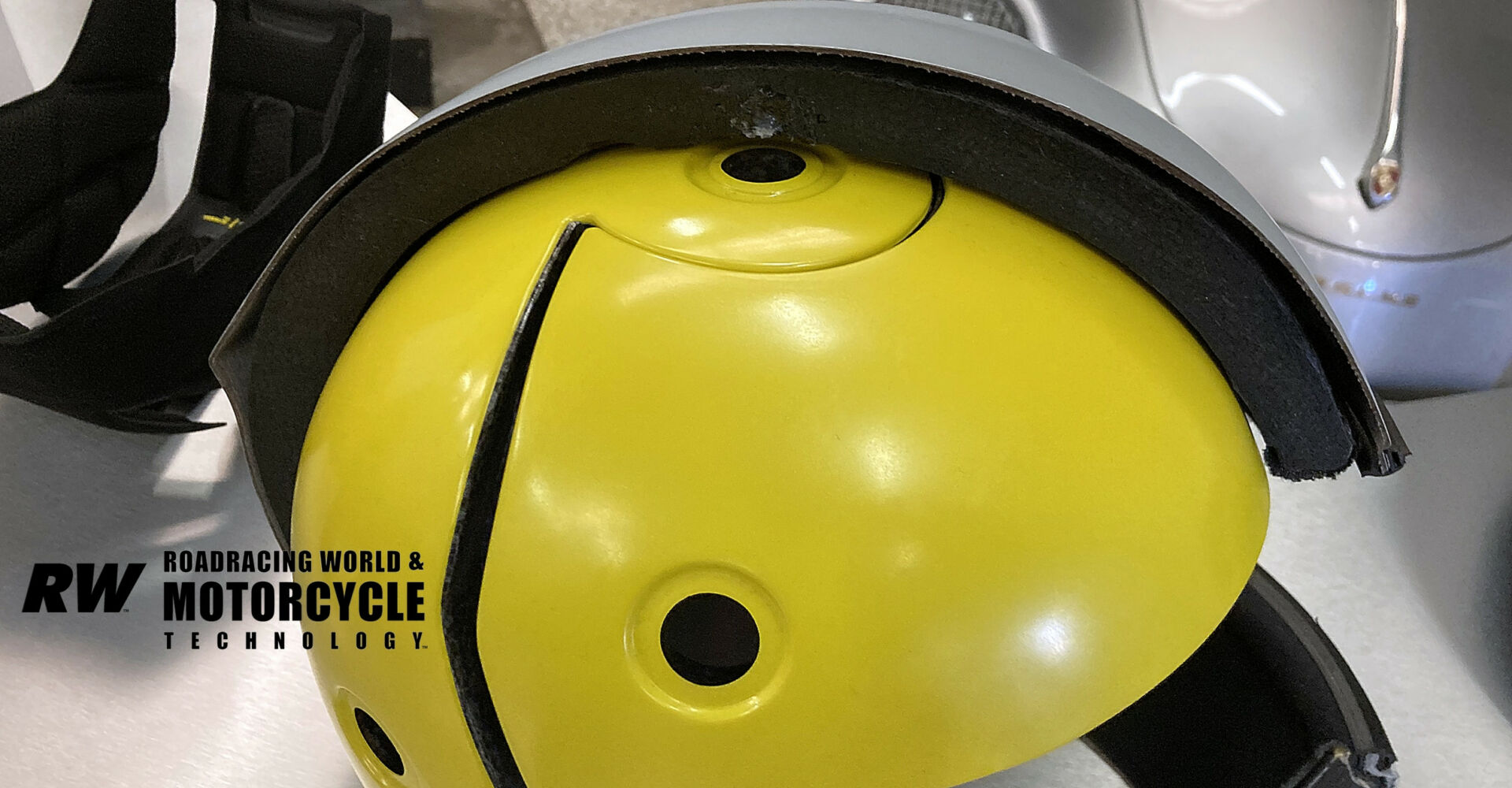
Central to the corporate’s expertise is a cut up lining. It’s primarily two totally different linings with a low-friction layer between them. In a crash that introduces angular momentum to the helmet, the low-friction layer permits the interior lining to slide between 10mm and 15mm in a timeframe of 5 to 10 milliseconds.
The newest design, on show on the gathering, introduces one other cut up, this one within the interior lining. Crossing from ear to ear excessive of the top, the second “slip” layer permits for extra movement and prevents the 2 foremost linings from “locking” collectively once they transfer, as they clearly should not completely spherical.
The corporate has huge expertise on this subject. Based in 2001, the corporate’s expertise first appeared in an equestrian helmet in 2007. Since then, the corporate has expanded to on- and off-road bike helmets, in addition to protecting headgear for snowboarding, bicycling, different sports activities, and for workplaces the place head safety is required. The corporate says greater than 30 million items with Mips expertise have been bought by greater than 150 manufacturers. The corporate doesn’t produce the liners, however companions with firms that produce its designs for helmet producers or works instantly with helmet producers to provide liners with Mips expertise.
Getting the trade to take rotational vitality attenuation severely has been a problem, Strandwitz says. Fewer than one p.c of the road helmets bought within the U.S., in addition to in Europe, incorporate Mips expertise, he says. And among the early “expertise” aimed toward rotational vitality attenuation truly diminished the effectiveness of the helmets they have been utilized in – some firms actually bought a bit of material that the person was speculated to put on between cranium and helmet, and that fabric allegedly would enable for “slip” in case of an angular hit. Provided that the power between head and helmet lining can exceed 750 kilograms, the corporate says, most cloth-like options truly diminished the flexibility for the top to slide. Have 10 adults stand on a bit of material and see how laborious it’s to tug. Now think about all of that gravitational power focused on a number of sq. inches, and you possibly can think about that it might be almost inconceivable to maneuver that fabric!
Strandwitz says that trendy rotational attenuation units, throughout all producers, have improved dramatically from earlier items. And he says that the Mips system addresses considerations that expertise designed to scale back the angular momentum transferred to the top compromised the efficiency of the liner. The thickest Mips low-friction layer is simply 0.7-0.8mm thick, and the quantity of potential lining materials it displaces is inconsequential.
Change is coming. The brand new ECE 22.06 commonplace for helmets will incorporate a take a look at for rotational vitality. And there are proposals to vary different helmet requirements, requiring producers to create helmets that soak up angular momentum.